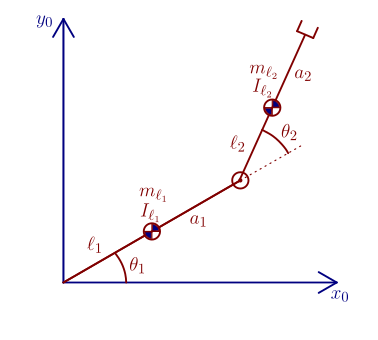
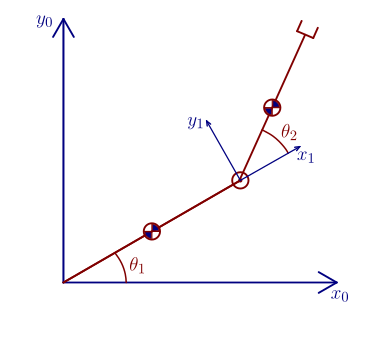
The two-link planar arm
\(\boldsymbol q = [\theta_1,\;\theta_2]^T\)
\(I_{l_1}, I_{l_2}\) : moments of inertia relative to the centers of mass
\(l_1, l_2\) : distances to the center of mass
\(a_1, a_2\) : link lengths (DH parameters)
The inertia matrix
\[B(\boldsymbol q)
= \sum_{i=1}^{2}
\Big[
m_{l_i}\,J_{P}^{l_i}(\boldsymbol q)^{T}J_{P}^{l_i}(\boldsymbol q)
+ J_{\theta}^{l_i}(\boldsymbol q)^{T}\,R_{i}\,I_{l_i}\,R_{i}^{T}\,J_{\theta}^{l_i}(\boldsymbol q)
\Big]\]
\[J_{P}^{\,l_i}(\boldsymbol q)
= \bigl[\,J_{P_1}^{\,l_i}\;\;J_{P_2}^{\,l_i}\;\dots\;J_{P_i}^{\,l_i}\;\;0\;\dots\;0\,\bigr]\]
\[J_{\theta}^{\,l_i}(\boldsymbol q)
= \bigl[\,J_{\theta_1}^{\,l_i}\;\;J_{\theta_2}^{\,l_i}\;\dots\;J_{\theta_i}^{\,l_i}\;\;0\;\dots\;0\,\bigr]\]
\[\begin{split}J_{P_j}^{\,l_i}
= \begin{cases}
z_{j-1}, & \text{for prismatic joint}\\[6pt]
z_{j-1}\times\bigl(\hat P_{l_i}-\hat P_{j-1}\bigr), & \text{for revolute joint}
\end{cases}\end{split}\]
\[\begin{split}J_{\theta_j}^{\,l_i}
= \begin{cases}
0, & \text{for prismatic joint}\\[3pt]
z_{j-1}, & \text{for revolute joint}
\end{cases}\end{split}\]
\[J_{P}^{\,l_1}(\boldsymbol q) \;=\;\bigl[J_{P_1}^{\,l_1}\;\;0\bigr],
\quad
J_{\theta}^{\,l_1}(\boldsymbol q) \;=\;\bigl[J_{\theta}^{\,l_1}\;\;0\bigr]\]
\[J_{P}^{\,l_2}(\boldsymbol q)
= \bigl[J_{P_1}^{\,l_2}\;\;J_{P_2}^{\,l_2}\bigr],
\quad
J_{\theta}^{\,l_2}(\boldsymbol q)
= \bigl[J_{\theta_1}^{\,l_2}\;\;J_{\theta_2}^{\,l_2}\bigr]\]
\[\begin{split}P_{1}
= \begin{bmatrix} a_1 c_1 \\[3pt] a_1 s_1 \\[3pt] 0 \end{bmatrix},
\quad
P_{0}
= \begin{bmatrix} 0 \\[3pt] 0 \\[3pt] 0 \end{bmatrix}\end{split}\]
\[\begin{split}P_{l_1}
= \begin{bmatrix} l_1 c_1 \\[3pt] l_1 s_1 \\[3pt] 0 \end{bmatrix},
\quad
P_{l_2}
= \begin{bmatrix}
a_1 c_1 + l_2 c_{12} \\[3pt]
a_1 s_1 + l_2 s_{12} \\[3pt]
0
\end{bmatrix}\end{split}\]
\[\begin{split}\begin{aligned}
J_{P_1}^{\,l_1}
&= \boldsymbol z_0 \times (\boldsymbol P_{l_1} - \boldsymbol P_0) \\[6pt]
&= \boldsymbol z_0 \times \bigl([\,l_1 c_1\; l_1 s_1\; 0]^T - [\,0\; 0\; 0]^T\bigr) \\[6pt]
&= [\,0\; 0\; 1]^T \times [\,l_1 c_1\; l_1 s_1\; 0]^T \\[6pt]
&= [\,-l_1 s_1\; l_1 c_1\; 0]^T
\end{aligned}\end{split}\]
\[\begin{split}\begin{aligned}
J_{P_2}^{\,l_2}
&= \boldsymbol z_0 \times (\boldsymbol P_{l_2} - \boldsymbol P_0) \\[6pt]
&= [\,0\; 0\; 1]^T
\times \Bigl([\,a_1 c_1 + l_2 c_{12}\; a_1 s_1 + l_2 s_{12}\; 0]^T
- [\,a_1 c_1\; a_1 s_1\; 0]^T\Bigr) \\[6pt]
&= [\,0\; 0\; 1]^T \times [\,l_2 c_{12}\; l_2 s_{12}\; 0]^T \\[6pt]
&= [\,-l_2 s_{12}\; l_2 c_{12}\; 0]^T
\end{aligned}\end{split}\]
\[\begin{split}J_{P}^{\,l_1}(\boldsymbol q)
= \begin{bmatrix}
-l_1 s_1 & 0 \\
l_1 c_1 & 0 \\
0 & 0
\end{bmatrix},
\quad
J_{P}^{\,l_2}(\boldsymbol q)
= \begin{bmatrix}
-a_1 s_1 - l_2 s_{12} & -l_2 s_{12} \\
a_1 c_1 + l_2 c_{12} & l_2 c_{12} \\
0 & 0
\end{bmatrix}\end{split}\]
\[\begin{split}J_{\theta}^{\,l_1}(\boldsymbol q)
= \begin{bmatrix}
0 & 0 \\
0 & 0 \\
1 & 0
\end{bmatrix},
\quad
J_{\theta}^{\,l_2}(\boldsymbol q)
= \begin{bmatrix}
0 & 0 \\
0 & 0 \\
1 & 1
\end{bmatrix}\end{split}\]
\[\begin{split}\begin{aligned}
B(\boldsymbol q)
&= m_{l_1}\,J_{P}^{\,l_1}(\boldsymbol q)^{T}J_{P}^{\,l_1}(\boldsymbol q)
+ J_{\theta}^{\,l_1}(\boldsymbol q)^{T}\,R_{1}\,I_{l_1}\,R_{1}^{T}\,J_{\theta}^{\,l_1}(\boldsymbol q)
+ m_{l_2}\,J_{P}^{\,l_2}(\boldsymbol q)^{T}J_{P}^{\,l_2}(\boldsymbol q)
+ J_{\theta}^{\,l_2}(\boldsymbol q)^{T}\,R_{2}\,I_{l_2}\,R_{2}^{T}\,J_{\theta}^{\,l_2}(\boldsymbol q) \\
&= B1+B2+B3+B4
\end{aligned}\end{split}\]
a) Linear part \(B1\) :
\[\begin{split}\begin{aligned}
m_{l_1}\,J_{P}^{l_1}(\boldsymbol q)^{T}J_{P}^{l_1}(\boldsymbol q)
&= m_{l_1}
\begin{bmatrix}
-l_1 s_1 & l_1 c_1 & 0 \\
0 & 0 & 0
\end{bmatrix}
\begin{bmatrix}
-l_1 s_1 & 0 \\
l_1 c_1 & 0 \\
0 & 0
\end{bmatrix} = \begin{bmatrix}
m_{l_1}\,l_1^2 & 0 \\
0 & 0
\end{bmatrix}
\end{aligned}\end{split}\]
b) Linear part \(B2\) :
\[\begin{split}\begin{aligned}
m_{l_2}\,J_{P}^{l_2}(\boldsymbol q)^{T}J_{P}^{l_2}(\boldsymbol q)
&= m_{l_2}
\begin{bmatrix}
-a_1 s_1 - l_2 s_{12} & -l_2 s_{12} \\
a_1 c_1 + l_2 c_{12} & l_2 c_{12} \\
0 & 0
\end{bmatrix}^{T}
\begin{bmatrix}
-a_1 s_1 - l_2 s_{12} & -l_2 s_{12} \\
a_1 c_1 + l_2 c_{12} & l_2 c_{12} \\
0 & 0
\end{bmatrix} \\[6pt]
&= m_{l_2}
\begin{bmatrix}
a_1^2 + l_2^2 + 2\,a_1\,l_2\,c_2
& a_1\,l_2\,c_2 + l_2^2 \\[3pt]
a_1\,l_2\,c_2 + l_2^2
& l_2^2
\end{bmatrix}
\end{aligned}\end{split}\]
c) Angular part \(B3\) :
\[\begin{split}\begin{aligned}
I_{l_1}
&= R_{1}\,I_{l_1}^{\,i}\,R_{1}^{T} \\[6pt]
&= \begin{bmatrix}
c_1 & -s_1 & 0 \\
s_1 & c_1 & 0 \\
0 & 0 & 1
\end{bmatrix}
\begin{bmatrix}
0 & 0 & 0 \\
0 & 0 & 0 \\
0 & 0 & I_{zz_1}
\end{bmatrix}
\begin{bmatrix}
c_1 & s_1 & 0 \\
-s_1 & c_1 & 0 \\
0 & 0 & 1
\end{bmatrix} = \begin{bmatrix}
0 & 0 & 0 \\
0 & 0 & 0 \\
0 & 0 & I_{zz_1}
\end{bmatrix}
\end{aligned}\end{split}\]
\[s_1\,s_{12} + c_1\,c_{12}
= s_1\,(s_1\,c_2 + c_1\,s_2) + c_1\,(c_1\,c_2 - s_1\,s_2)
= s_1^2\,c_2 + s_1\,c_1\,s_2 + c_1^2\,c_2 - s_1^2\,s_2
= c_2\]
\[\begin{split}J_{\theta}^{\,l_1}(\boldsymbol q)^{T}\,I_{l_1}\,J_{\theta}^{\,l_1}(\boldsymbol q)
= \begin{bmatrix}
0 & 0 & 1 \\
0 & 0 & 0
\end{bmatrix}
\begin{bmatrix}
0 & 0 & 0 \\
0 & 0 & 0 \\
0 & 0 & I_{zz_1}
\end{bmatrix}
\begin{bmatrix}
0 & 0 \\
0 & 0 \\
1 & 0
\end{bmatrix}
= \begin{bmatrix}
I_{zz_1} & 0 \\
0 & 0
\end{bmatrix}\end{split}\]
d) Angular part \(B4\) :
\[\begin{split}J_{\theta}^{\,l_2}(\boldsymbol q)^{T}\,I_{l_2}\,J_{\theta}^{\,l_2}(\boldsymbol q)
= \begin{bmatrix}
0 & 0 & 1 \\
0 & 0 & 1
\end{bmatrix}
\begin{bmatrix}
0 & 0 & 0 \\
0 & 0 & 0 \\
0 & 0 & I_{zz_2}
\end{bmatrix}
\begin{bmatrix}
0 & 0 \\
0 & 0 \\
1 & 1
\end{bmatrix}
= \begin{bmatrix}
I_{zz_2} & I_{zz_2} \\
I_{zz_2} & I_{zz_2}
\end{bmatrix}\end{split}\]
Finally:
\[\begin{split}B(\boldsymbol q)
= \begin{bmatrix}
m_{l_1}\,l_1^2
+ m_{l_2}\,\bigl(a_1^2 + l_2^2 + 2\,a_1\,l_2\,c_2\bigr)
+ I_{zz_1} + I_{zz_2}
& m_{l_2}\,\bigl(a_1\,l_2\,c_2 + l_2^2\bigr) + I_{zz_2} \\[6pt]
m_{l_2}\,\bigl(a_1\,l_2\,c_2 + l_2^2\bigr) + I_{zz_2}
& m_{l_2}\,l_2^2 + I_{zz_2}
\end{bmatrix}
= \begin{bmatrix}
b_{11} & b_{12} \\[3pt]
b_{21} & b_{22}
\end{bmatrix},
\quad b_{12} = b_{21}\end{split}\]
The Coriolis and centrifugal matrix
\[\begin{split}{\boldsymbol C}\bigl(\boldsymbol q,\dot{\boldsymbol q}\bigr)
= \begin{bmatrix}
C_{11} & C_{12} \\[3pt]
C_{21} & C_{22}
\end{bmatrix}\end{split}\]
\[C_{ij} = \sum_{k=1}^{n} C_{ijk}\,\dot q_k,
\quad
C_{ijk} = \tfrac12\!\Bigl(
\frac{\partial b_{ij}}{\partial q_k}
+ \frac{\partial b_{ik}}{\partial q_j}
- \frac{\partial b_{jk}}{\partial q_i}
\Bigr)\]
\[C_{11} = C_{111}\,\dot q_1 + C_{112}\,\dot q_2\]
\[C_{12} = C_{121}\,\dot q_1 + C_{122}\,\dot q_2\]
\[C_{21} = C_{211}\,\dot q_1 + C_{212}\,\dot q_2\]
\[C_{22} = C_{221}\,\dot q_1 + C_{222}\,\dot q_2\]
\[C_{111}
= \tfrac12\Bigl(
\frac{\partial b_{11}}{\partial q_{1}}
+ \frac{\partial b_{11}}{\partial q_{1}}
- \frac{\partial b_{11}}{\partial q_{1}}
\Bigr)
= 0\]
\[C_{112}
= \tfrac12\Bigl(
\frac{\partial b_{11}}{\partial q_{2}}
+ \frac{\partial b_{12}}{\partial q_{1}}
- \frac{\partial b_{12}}{\partial q_{1}}
\Bigr)
= -\,m_{l_{2}}\,a_{1}\,l_{2}\,s_{2}
= h\]
\[C_{121}
= \tfrac12\Bigl(
\frac{\partial b_{12}}{\partial q_{1}}
+ \frac{\partial b_{11}}{\partial q_{2}}
- \frac{\partial b_{21}}{\partial q_{1}}
\Bigr)
= -\,m_{l_{2}}\,a_{1}\,l_{2}\,s_{2}
= h\]
\[C_{112} = C_{121}\]
\[C_{122}
= \tfrac12\Bigl(
\frac{\partial b_{12}}{\partial q_{2}}
+ \frac{\partial b_{12}}{\partial q_{2}}
- \frac{\partial b_{22}}{\partial q_{2}}
\Bigr)
= \frac{\partial b_{12}}{\partial q_{2}}
- \tfrac12\underbrace{\frac{\partial b_{22}}{\partial q_{2}}}_{0}
= 0\]
\[C_{211}
= \tfrac12\Bigl(
\frac{\partial b_{21}}{\partial q_{1}}
+ \frac{\partial b_{21}}{\partial q_{1}}
- \frac{\partial b_{11}}{\partial q_{2}}
\Bigr)
= \underbrace{\frac{\partial b_{21}}{\partial q_{1}}}_{0}
- \tfrac12\frac{\partial b_{11}}{\partial q_{2}}
= -\,h\]
\[C_{212} = C_{221}
= \tfrac12\Bigl(
\frac{\partial b_{21}}{\partial q_{2}}
+ \frac{\partial b_{22}}{\partial q_{1}}
- \frac{\partial b_{12}}{\partial q_{2}}
\Bigr)
= \tfrac12\frac{\partial b_{22}}{\partial q_{1}}
= 0\]
\[C_{222}
= \tfrac12\Bigl(
\frac{\partial b_{22}}{\partial q_{2}}
+ \frac{\partial b_{22}}{\partial q_{2}}
- \frac{\partial b_{22}}{\partial q_{2}}
\Bigr)
= \tfrac12\frac{\partial b_{22}}{\partial q_{2}}
= 0\]
\[\begin{split}C(\,\boldsymbol q,\dot{\boldsymbol q}\,) \;=\;
\begin{bmatrix}
h\,\dot\theta_{2} & h\,\dot\theta_{1} \;+\; h\,\dot\theta_{2} \\[6pt]
-\,h\,\dot\theta_{1} & 0
\end{bmatrix}\end{split}\]
We can verify that
\({\boldsymbol N} = \dot{\boldsymbol B} \;-\; 2 {\boldsymbol C}\)
is skew-symmetric.
\[\begin{split}\dot{\boldsymbol B} \;=\;
\begin{bmatrix}
-2\,m_{l_2}\,a_{1}\,\ell_{2}\,s_{2}\,\dot\theta_{2}
& -\,m_{l_2}\,a_{1}\,\ell_{2}\,s_{2}\,\dot\theta_{2} \\[6pt]
-\,m_{l_2}\,a_{1}\,\ell_{2}\,s_{2}\,\dot\theta_{2}
& 0
\end{bmatrix}
\;=\;
\begin{bmatrix}
2\,h\,\dot\theta_{2} & h\,\dot\theta_{2} \\[6pt]
h\,\dot\theta_{2} & 0
\end{bmatrix}\end{split}\]
\[\begin{split}{\boldsymbol N} \;=\;
\begin{bmatrix}
2\,h\,\dot\theta_{2} & h\,\dot\theta_{2} \\[6pt]
h\,\dot\theta_{2} & 0
\end{bmatrix}
\;-\;2\,
\begin{bmatrix}
h\,\dot\theta_{2} & h\,\dot\theta_{1} \;+\; h\,\dot\theta_{2} \\[6pt]
-\,h\,\dot\theta_{1} & 0
\end{bmatrix}
\;=\;
\begin{bmatrix}
0 & -\,2\,h\,\dot\theta_{2} \;-\; h\,\dot\theta_{2} \\[6pt]
2\,h\,\dot\theta_{2} \;+\; h\,\dot\theta_{2} & 0
\end{bmatrix}\end{split}\]
Gravitational term
\[\begin{split}\boldsymbol g_{0} \;=\;
\begin{bmatrix}
0 \\[4pt]
-\,g \\[4pt]
0
\end{bmatrix}
\quad\text{then}\quad
\boldsymbol g(\boldsymbol q)\;=\;
\begin{bmatrix}
g_{1}(\boldsymbol q) \\[4pt]
g_{2}(\boldsymbol q)
\end{bmatrix}\end{split}\]
\[g_{i}(\boldsymbol q)
\;=\;
-\sum_{k=1}^{n} m_{l_k}\,\boldsymbol g_{0}^{T}\,J_{P_{i}}^{\,l_{k}}\]
\[\begin{split}g_{1}(\boldsymbol q)
\;=\;
-\,m_{l_1}\,\boldsymbol g_{0}^{T}\,J_{P_{1}}^{\,l_{1}}
\;-\;
m_{l_2}\,\boldsymbol g_{0}^{T}\,J_{P_{1}}^{\,l_{2}}\,;
\quad
J_{P}^{\,l_{1}}
\;=\;
\begin{bmatrix}
-\,\ell_{1}\,s_{1} & 0 \\[6pt]
\ell_{1}\,c_{1} & 0 \\[6pt]
0 & 0
\end{bmatrix}
\;=\;
\bigl[\,J_{P_{1}}^{\,l_{1}}\,,\,J_{P_{2}}^{\,l_{1}}\,\bigr]\end{split}\]
\[\begin{split}g_{2}(\boldsymbol q)
\;=\;
-\,m_{l_1}\,\boldsymbol g_{0}^{T}\,J_{P_{2}}^{\,l_{1}}
\;-\;
m_{l_2}\,\boldsymbol g_{0}^{T}\,J_{P_{2}}^{\,l_{2}}\,;
\quad
J_{P}^{\,l_{2}}
\;=\;
\begin{bmatrix}
-\,a\,s_{1} \;-\; \ell_{2}\,s_{12}
& -\,\ell_{2}\,s_{12} \\[6pt]
a\,c_{1} \;+\; \ell_{2}\,c_{12}
& \ell_{2}\,c_{12} \\[6pt]
0 & 0
\end{bmatrix}
\;=\;
\bigl[\,J_{P_{1}}^{\,l_{2}}\,,\,J_{P_{2}}^{\,l_{2}}\,\bigr]\end{split}\]
\[g_{1}(\boldsymbol q)=m_{l_1}\,g\,\ell_{1}\,c_{1}+m_{l_2}\,g\,(a_{1}\,c_{1}+\ell_{2}\,c_{12})\]
\[g_{2}(\boldsymbol q)=m_{l_2}\,g\,\ell_{2}\,c_{12}\]
Equations of motion
Finally, the equations of motion (without friction) are:
\[B(\boldsymbol q)\,\ddot{\boldsymbol q}
\;+\;
C(\boldsymbol q,\dot{\boldsymbol q})\,\dot{\boldsymbol q}
\;+\;
g(\boldsymbol q)
\;=\;
\boldsymbol \tau\]
\[b_{11}\,\ddot\theta_{1}
+ b_{12}\,\ddot\theta_{2}
+ c_{11}\,\dot\theta_{1}
+ c_{12}\,\dot\theta_{2}
+ g_{1} = \tau_{1}\]
\[b_{21}\,\ddot\theta_{1}
+ b_{22}\,\ddot\theta_{2}
+ c_{21}\,\dot\theta_{1}
+ c_{22}\,\dot\theta_{2}
+ g_{2} = \tau_{2}\]
\[\begin{split}\text{I:}\quad
\begin{aligned}
& (m_{l_1}\ell_{1}^{2}+m_{2}(a_{1}^{2}+\ell_{2}^{2}+2a_{1}\ell_{2}c_{2})
+I_{l_1}+I_{l_2})\,\ddot\theta_{1}\\
&\quad + (m_{l_2}(a_{1}\ell_{2}c_{2}+\ell_{2}^{2})+I_{2})\,\ddot\theta_{2}\\
&\quad + (-m_{l_2}a_{1}\ell_{2}s_{2}\,\dot\theta_{2})\,\dot\theta_{1}\\
&\quad + (-m_{l_2}a_{1}\ell_{2}s_{2}\,\dot\theta_{1}
-m_{l_2}a_{1}\ell_{2}s_{2}\,\dot\theta_{2})\,\dot\theta_{2}\\
&\quad + (m_{1}g\ell_{1}c_{1}
+m_{l_2}g(a_{1}c_{1}+\ell_{2}c_{12}))
= \tau_{1}
\end{aligned}\end{split}\]
\[\begin{split}\text{II:}\quad
\begin{aligned}
& (m_{l_2}(a_{1}\ell_{2}c_{2}+\ell_{2}^{2})+I_{2})\,\ddot\theta_{1}\\
&\quad + (m_{l_2}\ell_{2}^{2}+I_{2})\,\ddot\theta_{2}\\
&\quad + (m_{l_2}a_{1}\ell_{2}s_{2}\,\dot\theta_{1})\,\dot\theta_{1}\\
&\quad + 0\\
&\quad + (m_{l_2}g\ell_{2}c_{12})
= \tau_{2}
\end{aligned}\end{split}\]
Parameterization
To finish with this example, let’s derive the parameterization of the dynamic model i.e.:
\[\boldsymbol \tau = y(\boldsymbol q,\dot{\boldsymbol q},\ddot{\boldsymbol q})\,\boldsymbol \pi\]
\[\begin{split}\boldsymbol \tau =
\begin{bmatrix}
\tau_{1}\\[4pt]
\tau_{2}
\end{bmatrix}
=
\begin{bmatrix}
y_{11}^{T} & y_{12}^{T}\\[2pt]
0 & y_{22}^{T}
\end{bmatrix}
\begin{bmatrix}
\boldsymbol \pi_{1}\\[2pt]
\boldsymbol \pi_{2}
\end{bmatrix}
=
\begin{bmatrix}
y_{111} & y_{112} & y_{121} & y_{122}\\[4pt]
0 & 0 & y_{221} & y_{222}
\end{bmatrix}
\begin{bmatrix}
\boldsymbol \pi_{11}\\[2pt]
\boldsymbol \pi_{12}\\[2pt]
\boldsymbol \pi_{21}\\[2pt]
\boldsymbol \pi_{22}
\end{bmatrix}\end{split}\]
\[\begin{split}\boldsymbol \pi_{1} =
\begin{bmatrix}
m_{l_1}\\
I_{l_1}
\end{bmatrix},
\quad
\boldsymbol \pi_{2} =
\begin{bmatrix}
m_{l_2}\\
I_{l_2}
\end{bmatrix}\end{split}\]
Expression I and II can be rewritten as:
\[\tau_{1}
= y_{11}\,m_{l_1}
+ y_{12}\,I_{l_1}
+ y_{21}\,m_{l_2}
+ y_{22}\,I_{l_2}\]
\[\tau_{2}
= y_{221}\,m_{l_2}
+ y_{222}\,I_{l_2}\]
with:
\[y_{111}
= \ell_{1}^{2}\,\ddot\theta_{1}
+ g\,\ell_{1}\,c_{1}\]
\[y_{112}
= \ddot\theta_{1}\]
\[y_{121}
= (a_{1}^{2} + \ell_{2}^{2} + 2\,a_{1}\,\ell_{2}\,c_{2})\,\ddot\theta_{1}
+ (a_{1}\,\ell_{2}\,c_{2} + \ell_{2}^{2})\,\ddot\theta_{2}
- 2\,a_{1}\,\ell_{2}\,s_{2}\,\dot\theta_{1}\,\dot\theta_{2}
- a_{1}\,\ell_{2}\,s_{2}\,\dot\theta_{2}^{2}
+ g\,(a_{1}\,c_{1} + \ell_{2}\,c_{12})\]
\[y_{122}
= \ddot\theta_{1}
+ \ddot\theta_{2}\]
\[y_{221}
= (a_{1}\,\ell_{2}\,c_{2} + \ell_{2}^{2})\,\ddot\theta_{1}
+ \ell_{2}^{2}\,\ddot\theta_{2}
+ a_{1}\,\ell_{2}\,s_{2}\,\dot\theta_{1}^{2}
+ g\,\ell_{2}\,c_{12}\]
\[y_{222}
= \ddot\theta_{1}
+ \ddot\theta_{2}\]
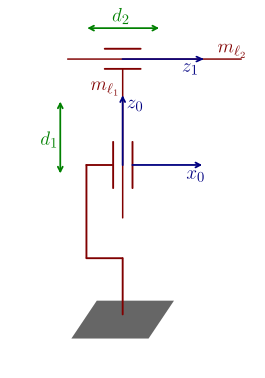
The two-link Cartesian arm
\[\begin{split}\boldsymbol q = \begin{bmatrix} d_{1} \\ d_{2} \end{bmatrix},
\quad
m_{l_1},\,m_{l_2}\text{: masses of the two links}\end{split}\]
\[B(\boldsymbol q)
= \sum_{i=1}^{n}
\Bigl[
m_{l_i}\,J_{P}^{\,l_{i}T}\,J_{P}^{\,l_{i}}
+ J_{\theta}^{\,l_{i}T}\,R_{i}^{T}\,I_{i}^{\,l_{i}}\,R_{i}\,J_{\theta}^{\,l_{i}}
\Bigr]\]
\[J_{P}^{\,l_{i}}
= \bigl[\,J_{P_{1}}^{\,l_{i}}\;J_{P_{2}}^{\,l_{i}}\;\dots\;J_{P_{n}}^{\,l_{i}}\;0\;\dots\;0\bigr]\]
\[J_{\theta}^{\,l_{i}}
= \bigl[\,J_{\theta_{1}}^{\,l_{i}}\;J_{\theta_{2}}^{\,l_{i}}\;\dots\;J_{\theta_{i}}^{\,l_{i}}\;0\;\dots\;0\bigr]\]
\[\begin{split}J_{P_{j}}^{\,l_{i}}
=
\begin{cases}
\boldsymbol z_{j-1},
& \text{for prismatic joints},\\[4pt]
\boldsymbol z_{j-1}\times\bigl(P_{i}-P_{j-1}\bigr),
& \text{for revolute joints}.
\end{cases}\end{split}\]
\[\begin{split}J^{\,l}_{\theta_{j}}
=
\begin{cases}
0 & \text{for prismatic joints}\\[4pt]
\boldsymbol z_{j-1} & \text{for revolute joints}
\end{cases}\end{split}\]
In the case of the two-link Cartesian arm we have:
\[\begin{split}J_{P}^{\,l_{1}}
=
\begin{bmatrix}
0 & 0\\
0 & 0\\
1 & 0
\end{bmatrix}
\quad
J_{P}^{\,l_{2}}
=
\begin{bmatrix}
0 & 1\\
0 & 0\\
1 & 0
\end{bmatrix}
\quad
J_{\theta}^{\,l_{1}} = J_{\theta}^{\,l_{2}} = 0\end{split}\]
\[B(\boldsymbol q)
= m_{l_1}\,J_{P}^{\,l_{1}T}\,J_{P}^{\,l_{1}}
+ m_{l_2}\,J_{P}^{\,l_{2}T}\,J_{P}^{\,l_{2}}\]
\[\begin{split}\quad=
m_{l_1}
\begin{bmatrix}
0 & 0 & 1\\
0 & 0 & 0
\end{bmatrix}
\begin{bmatrix}
0 & 0\\
0 & 0\\
1 & 0
\end{bmatrix}
+ m_{l_2}
\begin{bmatrix}
0 & 0 & 1\\
1 & 0 & 0
\end{bmatrix}
\begin{bmatrix}
0 & 1\\
0 & 0\\
1 & 0
\end{bmatrix}\end{split}\]
\[\begin{split}\quad=
\begin{bmatrix}
m_{l_1} & 0\\
0 & 0
\end{bmatrix}
+
\begin{bmatrix}
m_{l_2} & 0\\
0 & m_{l_2}
\end{bmatrix}
=
\begin{bmatrix}
m_{l_1}+m_{l_2} & 0\\
0 & m_{l_2}
\end{bmatrix}\end{split}\]
Note
The \(B\) is constant, i.e. it does not depend on the arm configuration.
This implies also that \(\boxed{C = 0}\) , i.e.there are no contributions of centrifugal or Coriolis forces.
Gravitational term:
\[\boldsymbol g_{0}
=
\begin{bmatrix}
0 & 0 & -g
\end{bmatrix}^{T}\]
\[\begin{split}\boldsymbol g(\boldsymbol q)
=
\begin{bmatrix}
g_{1}(\boldsymbol q)\\
g_{2}(\boldsymbol q)
\end{bmatrix}\end{split}\]
\[g_{i}(\boldsymbol q)
= -\sum_{j=1}^{n} m_{j}\,\boldsymbol g_{0}^{T}\,J_{P}^{\,l_{j}}\]
\[g_{1}
= -\,m_{l_{1}}\;\boldsymbol g_{0}^{T}\;J_{P_{1}}^{\,l_{1}}
\;-\;m_{l_{2}}\;\boldsymbol g_{0}^{T}\;J_{P_{1}}^{\,l_{2}}\]
\[\begin{split}g_{1}
= -\,m_{l_{1}}\,[0\ 0\ -g]
\begin{bmatrix}
0 \\[3pt]
0 \\[3pt]
1
\end{bmatrix}
\;-\;
m_{l_{2}}\,[0\ 0\ -g]
\begin{bmatrix}
0 \\[3pt]
0 \\[3pt]
1
\end{bmatrix}
= (m_{l_{1}} + m_{l_{2}})\,g\end{split}\]
\[g_{2}
= -\,m_{l_{1}}\;\boldsymbol g_{0}^{T}\;J_{P_{2}}^{\,l_{1}}
\;-\;m_{l_{2}}\;\boldsymbol g_{0}^{T}\;J_{P_{2}}^{\,l_{2}}\]
\[\begin{split}g_{2}
= -\,m_{l_{1}}\,[0\ 0\ -g]
\begin{bmatrix}
0 \\[3pt]
0 \\[3pt]
0
\end{bmatrix}
\;-\;
m_{l_{2}}\,[0\ 0\ -g]
\begin{bmatrix}
0 \\[3pt]
0 \\[3pt]
0
\end{bmatrix}
= 0\end{split}\]
\[\boldsymbol g(\boldsymbol q)
=
\begin{bmatrix}
(m_{l_{1}} + m_{l_{2}})\,g & 0
\end{bmatrix}\]
Finally, the dynamic model is:
\[\begin{split}\left\{
\begin{aligned}
(m_{l_{1}} + m_{l_{2}})\,\ddot d_{1}
+ (m_{l_{1}} + m_{l_{2}})\,g &= z_{1},\\[4pt]
m_{l_{2}}\;\ddot d_{2} &= z_{2}.
\end{aligned}
\right.\end{split}\]
A completely decoupled dynamic appears, as a result of the Cartesian structure and the particular choice of the axes (the second axis being perpendicular to the first makes the inertia matrix a diagonal one).